Qwen 4 (Qwen4) is the next generation of large language models from Alibaba's Qwen team. Qwen4-Max is the first officially released flagship model in the Qwen4 family. Launched on November 16, 2026, it supports a 1-million-token context window, understands text, images, and video, and can perform multi-step tasks through code generation, tool calling, and structured output.
Qwen4-Max uses a Mixture-of-Experts (MoE) architecture, with approximately 2.4 trillion total parameters and 71 billion active parameters per token. Its preview version, qwen4-max-preview, became available on November 11. The official release introduced usage-based API billing under the model ID qwen4-max. Alibaba has also announced plans to release the weights of smaller Qwen4 models.
Official Qwen announcement · Alibaba Cloud Model Studio documentation
How powerful is Qwen4-Max? Can it compete with Claude Opus 5.5?
Based on its launch benchmarks, Qwen4-Max is competitive with leading frontier models in certain tasks, particularly web development. However, its overall performance is closer to Kimi K3.1 Pro than Claude Opus 5.5. The available results do not support treating it as a complete replacement for Opus 5.5.
In Artificial Analysis's independent Intelligence Index, Qwen4-Max scored 43, up from 34 for Qwen3.8-Max and close to Kimi K3.1 Pro's 46. Claude Opus 5.5 scored 59.
The gap is smaller in web development. Qwen4-Max reached 1,750 Elo and initially ranked sixth on WebDev Arena, compared with 1,816 Elo and second place for Opus 5.5.
These results make Qwen4-Max worth evaluating for frontend development. For complex repository-level engineering, long-running terminal tasks, or demanding professional reasoning, it should still be tested against Opus 5.5, Kimi K3.1 Pro, and other leading models before replacing them.
Artificial Analysis · WebDev Arena
Qwen4-Max Benchmarks: How Much Better Is It Than Qwen3.8-Max?
Qwen4-Max's initial evaluations cover web development, software engineering, agent workflows, professional knowledge, and multimodal understanding.
Different organizations use different benchmark suites and reasoning configurations, so their scores should not be compared directly.
The following table prioritizes independent results from Artificial Analysis, Arena, and Vals AI. All three organizations published evaluations of the official release, primarily using the xhigh reasoning setting.
| Benchmark | Qwen4-Max | Comparison |
|---|---|---|
| Artificial Analysis Intelligence Index | 43 | Qwen3.8-Max: 34; Kimi K3.1 Pro: 46; Opus 5.5: 59 |
| WebDev Arena | 1,750 Elo, #6 | Qwen3.8-Max: 1,676; Opus 5.5: 1,816 |
| Image-to-WebDev | 1,674 Elo, #6 | Qwen3.8-Max: 1,639 |
| Vals Index v2.2 | 63.20%, #11/38 | Qwen3.8-Max: 59.05%; Kimi K3.1 Pro: 62.52% |
| Vibe Code Bench v1.1 | 86.66%; 21/50 applications passed all tests | Qwen3.8-Max: 16/50 |
| Terminal-Bench 4.0 | Approximately 48.5% | Qwen3.8-Max: 38.9%; Kimi K3.1 Pro: approximately 67% |
| AA-Briefcase v1.1 | 1,686 Elo | Qwen3.8-Max: 1,604; Opus 5.5: 1,801 |
| AutomationBench-AA | Approximately 73% | Qwen3.8-Max: 56%; Opus 5.5: 70% |
| Finance Agent v2.1 | 66.68% | Ranked #8 by Vals AI |
| Tax Agent Bench | 40.35% | Qwen3.8-Max: 49.7% |
| Legal Research Bench | 41.35% | Qwen3.8-Max: 46.2% |
Arena rankings are preliminary launch results and may change as more votes are collected. Vals AI rankings reflect the available model-page data; leaderboard sizes may vary over time.
Artificial Analysis results · Vals AI model page · WebDev Arena leaderboard
Web Development Is One of Its Strongest Areas
Qwen4-Max improved by 74 Elo over its predecessor on WebDev Arena. It also performed better on the Image-to-WebDev benchmark, which evaluates how well models turn screenshots into functional web pages.
Vals AI tested both generations on 50 web application development tasks. Qwen4-Max passed all tests on 21 applications, compared with 16 for Qwen3.8-Max.
Both evaluations point to meaningful improvements in frontend generation and interactive application development.
However, the gap between Qwen4-Max's 1,750 Elo and Opus 5.5's 1,816 Elo remains substantial enough to matter. Visual quality, functional correctness, and the ability to modify an existing project over multiple iterations should also be evaluated separately.
Complex Coding and Professional Tasks Remain Weaker
On Terminal-Bench 4.0, Qwen4-Max scored approximately 48.5%, improving on Qwen3.8-Max's 38.9% but remaining behind Kimi K3.1 Pro's approximately 67%.
In Alibaba's published ProgramBench software-replication benchmark, Qwen4-Max scored 31.5, compared with 65.0 for Opus 5.5.
Although Qwen4-Max performs competitively on some software engineering benchmarks, this result points to a significant remaining gap in complex, extended coding tasks.
Professional benchmarks also show mixed results.
Vals AI reported a score of 66.68% on Finance Agent v2.1. However, its Tax Agent Bench score declined from 49.7% for the previous generation to 40.35%, while Legal Research Bench fell from 46.2% to 41.35%.
Companies evaluating AI models for financial, tax, or legal work should therefore prioritize task-specific results rather than relying entirely on an overall intelligence ranking.
Vals AI detailed results · Qwen's published benchmark comparisons

Three Real-World Tests: What Can Qwen4-Max Actually Build?
Beyond benchmark scores, developers have already published execution logs and working examples using the official model.
The following three tests illustrate web application generation, design differences between models, and the impact of reasoning settings on speed and token consumption.
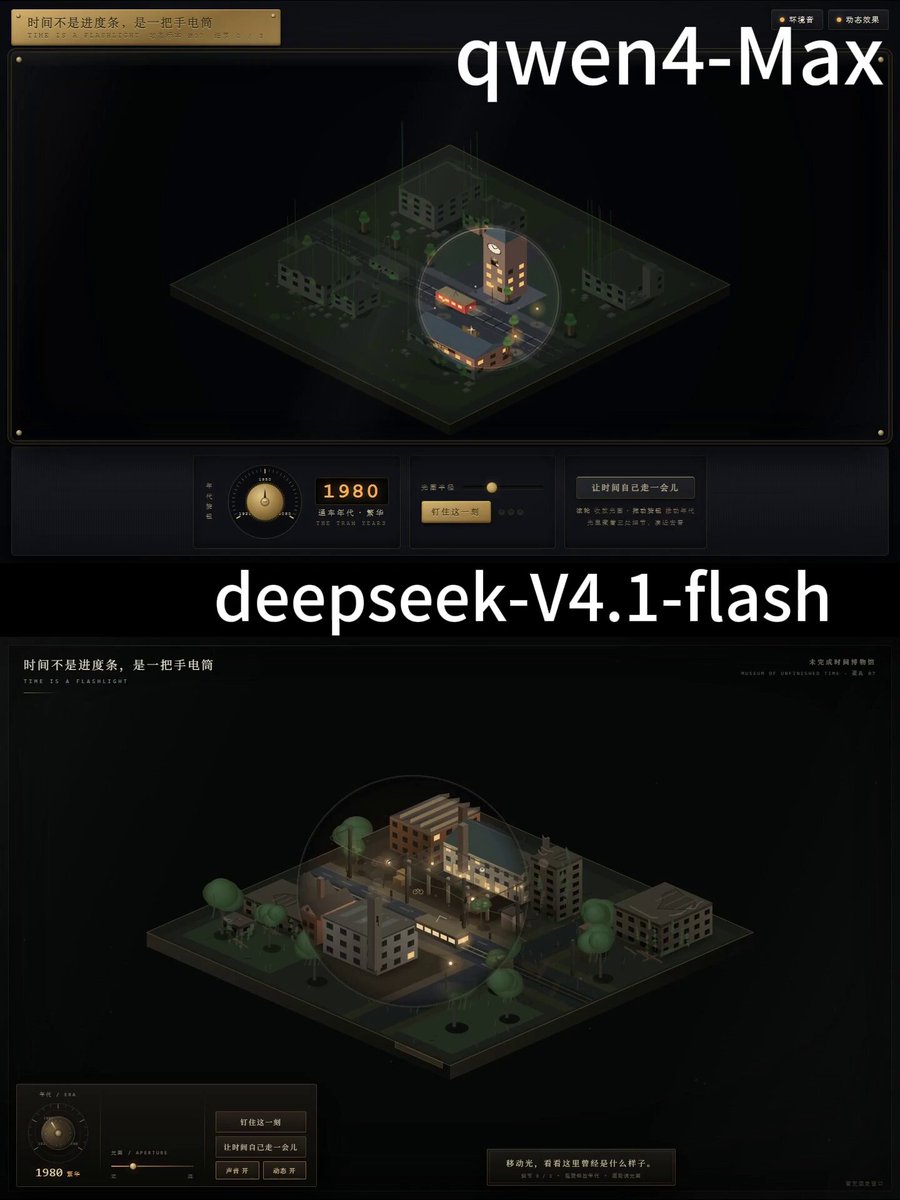
1. Same Web Development Task: Qwen4-Max Finished 31 Minutes and 24 Seconds Ahead of DeepSeek V4.1 Flash
Developer Densitylucky gave Qwen4-Max and DeepSeek V4.1 Flash the same task: build an interactive miniature city displayed inside a glass case.
The mouse cursor acts as a "time flashlight." Moving it across the scene reveals what different parts of the city would look like in 1920, 1980, or 2080.
Buildings must remain aligned across different eras. Users must also be able to pin multiple time windows and compare different periods on the same map.
Both models produced working demonstrations in which buildings changed according to the selected era.
The Qwen4-Max demonstration additionally showed multiple pinned time windows displayed simultaneously.
The developer reported the following completion times:
| Model | Completion Time |
|---|---|
| Qwen4-Max | 13 minutes 31 seconds |
| DeepSeek V4.1 Flash | 44 minutes 55 seconds |
Qwen4-Max finished 31 minutes and 24 seconds earlier in this particular test.
However, the developer did not disclose the complete reasoning configurations, API costs, or itemized acceptance-test results for either model. These timings should not be interpreted as a general measure of relative speed.
Developer's original post and side-by-side video
2. Arena Side-by-Side Tests: Design Differences Between Qwen4-Max, GPT, and Claude
Arena's Peter Gostev published a collection of model-generated projects, including a voxel-style Roman city, 3D scenes, small games, and interactive websites.
One particularly useful example is a racing event dashboard.
Qwen4-Max arranged the track, race statistics, and driver list into a compact, information-dense control panel.
GPT-6.1 Sol allocated more space to the track visualization, making it the central visual element.
Both designs addressed the main requirements, but their layout decisions were different.
This comparison does not establish that either model is universally better. It does, however, help developers evaluate which model's design choices better match their own requirements.
To inspect the results directly, start at 13:36 in the video for website design and continue to 15:47 for the web usability comparison.
Arena side-by-side model comparison

3. Simon Willison's Test: xhigh Took Almost Six Minutes Longer Than high
Developer Simon Willison tested Qwen4-Max through OpenRouter using four reasoning configurations and the same prompt:
Generate an SVG of a pelican riding a bicycleThe task was to generate an SVG illustration of a pelican riding a bicycle.
The results were:
| Reasoning Setting | Time | Output Tokens (Including Reasoning) |
|---|---|---|
| Disabled | 1 min 01 sec | 3,766 |
| low | 1 min 31 sec | 5,702 |
| high | 1 min 37 sec | 6,362 |
| xhigh | 7 min 23 sec | 26,295 |
The xhigh output included additional visual details, such as a teal bicycle, a red scarf, and a fish with its tail sticking out.
However, it took approximately 4.5 times as long as high and consumed roughly 4.1 times as many output tokens.
Willison also tested Qwen3.8-Max on the same prompt.
He generally preferred Qwen4-Max's results, but when comparing only the xhigh outputs, he preferred the illustration produced by the previous-generation model.
The test shows why higher reasoning settings are not automatically better. Additional reasoning tokens may improve details, but they also increase latency and cost without guaranteeing a better result every time.
Original execution logs · SVG output previews · Willison's comparison
How Much Cheaper Is Qwen4-Max Than Qwen3.8-Max?
Besides performance improvements, Qwen4-Max substantially reduces the average cost of completing benchmark tasks.
Artificial Analysis evaluated both generations using the xhigh reasoning setting and reported the following results:
| Metric | Qwen3.8-Max | Qwen4-Max |
|---|---|---|
| Intelligence Index | 34 | 43 |
| Average cost per task | US$10.02 | US$3.27 |
| Average output tokens per task | Approximately 171,000 | Approximately 105,000 |
In this benchmark, the average task cost declined by approximately 67%.
Lower API prices explain part of the reduction. The newer model also used fewer output tokens on average to complete the same benchmark suite.
Artificial Analysis cost breakdown
Alibaba observed a similar trend in its internal Work360 evaluation.
Qwen4-Max improved the score from 47.74 to 52.69, while the average cost per task decreased from US$4.43 to US$1.67, a reduction of approximately 62%.
However, Work360 is a vendor-reported evaluation. Its tasks, configurations, and pricing assumptions differ from those used by Artificial Analysis, so the two cost figures should not be combined.
Qwen Work360 cost results · Work360 benchmark scores

For real development workflows, a more useful metric is the total cost of reaching an accepted result, including initial generation, retries, debugging, and necessary human intervention.
How to Use Qwen4-Max: Where Can You Try It?
Alibaba lists Qwen Studio, QwenWork, and Qoder as ways to access Qwen4.
If you simply want to try its text generation or coding capabilities, you can start with one of the official products.
Developers who need to integrate the model into an application or agent system can use Alibaba Cloud Model Studio or OpenRouter.
- Qwen Studio · Try Qwen models online
- QwenWork · Qwen's work-oriented AI experience
- Qoder · AI-powered software development
- Alibaba Cloud Model Studio · API model ID:
qwen4-max - OpenRouter · API model ID:
qwen/qwen4-max
The official Qwen4-Max release supports OpenAI Chat Completions, Responses, Anthropic Messages, and DashScope interfaces.
It also supports tool calling, parallel tool calling, and structured JSON output.
The earlier qwen4-max-preview model was offered through the Token Plan. The official qwen4-max model now supports usage-based API billing.
When integrating the model, make sure you are selecting the official release rather than the preview model.
Alibaba Cloud documentation · Preview model documentation
Qwen4-Max API Pricing
Alibaba Cloud Model Studio pricing varies by deployment region.
The following table shows published standard rates as checked on November 16, 2026. All prices are per million tokens.
| Region and Deployment Scope | Input | Output | Cache Hit |
|---|---|---|---|
| US Virginia — Global Deployment | US$1.413 | US$4.24 | US$0.071 |
| Singapore — International Deployment | US$1.50 | US$4.50 | US$0.075 |
| Beijing — Mainland China Deployment | ¥10 | ¥30 | ¥0.50 |
Reasoning tokens are charged as output tokens.
The cache-hit prices shown above are not the same as cache creation prices. Explicit cache creation may be billed separately.
Compared with Qwen3.8-Max in the same deployment region, Qwen4-Max's standard input and output token prices are approximately 14.4% lower in Virginia and 25% lower in Singapore.
Alibaba Cloud international pricing · Mainland China pricing
What Should Developers Know Before Using the API?
Qwen4-Max supports a context window of up to 1 million tokens, making it suitable for tasks involving lengthy documents or large amounts of project context.
However, the ability to accept a long context does not guarantee that the model can accurately retrieve or reference every detail within it.
Reasoning settings also affect output token usage, latency, and costs. Developers should not automatically use xhigh for every task.
To integrate Qwen4-Max through Alibaba Cloud Model Studio, create an API key for the appropriate region, configure the corresponding API endpoint, and set the model ID to qwen4-max.
When using OpenRouter, the model ID is qwen/qwen4-max. Its model page also provides information about reasoning configurations and pricing.
Is Qwen4-Max Worth Using?
If your work involves frontend prototypes, interactive websites, or development tasks with clear acceptance criteria, Qwen4-Max is worth testing.
A practical evaluation is to take a screenshot from a project you know well and give Qwen4-Max and your current model the same task.
Start with the high reasoning setting and define a few concrete acceptance criteria:
- The layout should closely match the reference.
- Essential interactive features must work correctly.
- The page must remain usable on narrow screens.
Then record the total time, token consumption, retries, and manual changes required to pass those checks.
Only increase the reasoning setting if the additional cost produces a meaningful improvement.
If your team currently relies on Opus 5.5 or Kimi K3.1 Pro for repository maintenance, complex terminal operations, or long-running agent workflows, test Qwen4-Max against your most frequent real tasks before migrating.
Its independent benchmark results in terminal programming and professional workflows do not yet establish that it can fully replace those models.
The launch results show substantial improvements over Qwen3.8-Max across multiple areas, particularly web development. API prices and average task costs have also declined.
Whether Qwen4-Max should replace an existing frontier model ultimately depends on task completion rates, latency, and total cost under your actual workload.
Note: This article summarizes initial results published around the official Qwen4-Max release on November 16, 2026. Arena rankings are dynamic, and some results remain preliminary. Artificial Analysis and Vals AI provide independent evaluations, while Work360, ProgramBench, and other results published by Alibaba are identified as vendor-reported benchmarks. Individual developer tests demonstrate performance on their specific tasks and should not be treated as comprehensive model evaluations.
References
- Official Qwen announcement
- Alibaba Cloud Model Studio documentation
- Artificial Analysis
- WebDev Arena
- Vals AI model page
More sources
- Qwen's published benchmark comparisons
- Developer's original post and side-by-side video
- Arena side-by-side model comparison
- Original execution logs
- SVG output previews
- Willison's comparison
- Artificial Analysis cost breakdown
- Qwen Work360 cost results
- Work360 benchmark scores
- Qwen Studio
- QwenWork
- Qoder
- OpenRouter
- Preview model documentation
- Alibaba Cloud international pricing
- Mainland China pricing