If that sounds familiar, I hope this list helps you find an AI agent that works for you. We've put together seven options, comparing what they can do for a small business, how they charge, and how complicated they are to set up and use.
AI agents for small business at a glance
| Product | Main considerations | Main uses | Starting price and requirements |
|---|---|---|---|
| Claude Team | Usage limits and actions available in connected apps | Documents, research and code | $20 per person/month billed annually; two-seat minimum |
| ChatGPT Business | Included usage and connected-app permissions | Research, documents and shared agents | $20 per person/month billed annually; two-seat minimum |
| Offloop | Access and available features | Teamwork with AI agents | Private beta / custom team pilot |
| Zapier | Task consumption and AI-step plan requirements | Cross-app workflows | Professional from $19.99/month billed annually |
| n8n | Setup work, model costs and hosting | Flexible workflows | Hosted Starter at €20/month billed annually |
| Lindy | Active-user seats and usage credits | Email, calendars and recurring work | From $29.99 per active user/month, including 3,000 credits |
| Intercom Fin | Minimum commitments and possible helpdesk costs | Customer support | From $0.99 per billable outcome |
Prices were checked against the linked vendor information on November 2, 2026. Taxes, region, billing period, usage and required licenses can affect the total.
How we selected these AI agents
We looked for products that could handle common small-business jobs: research, administration, workflow automation, customer support and teamwork. We reviewed public pricing and access-control information, noting where a capability requires a particular setup. We haven't tested every product on the same tasks or verified returns on investment.

1. Claude Team: my first choice for everyday small-business work
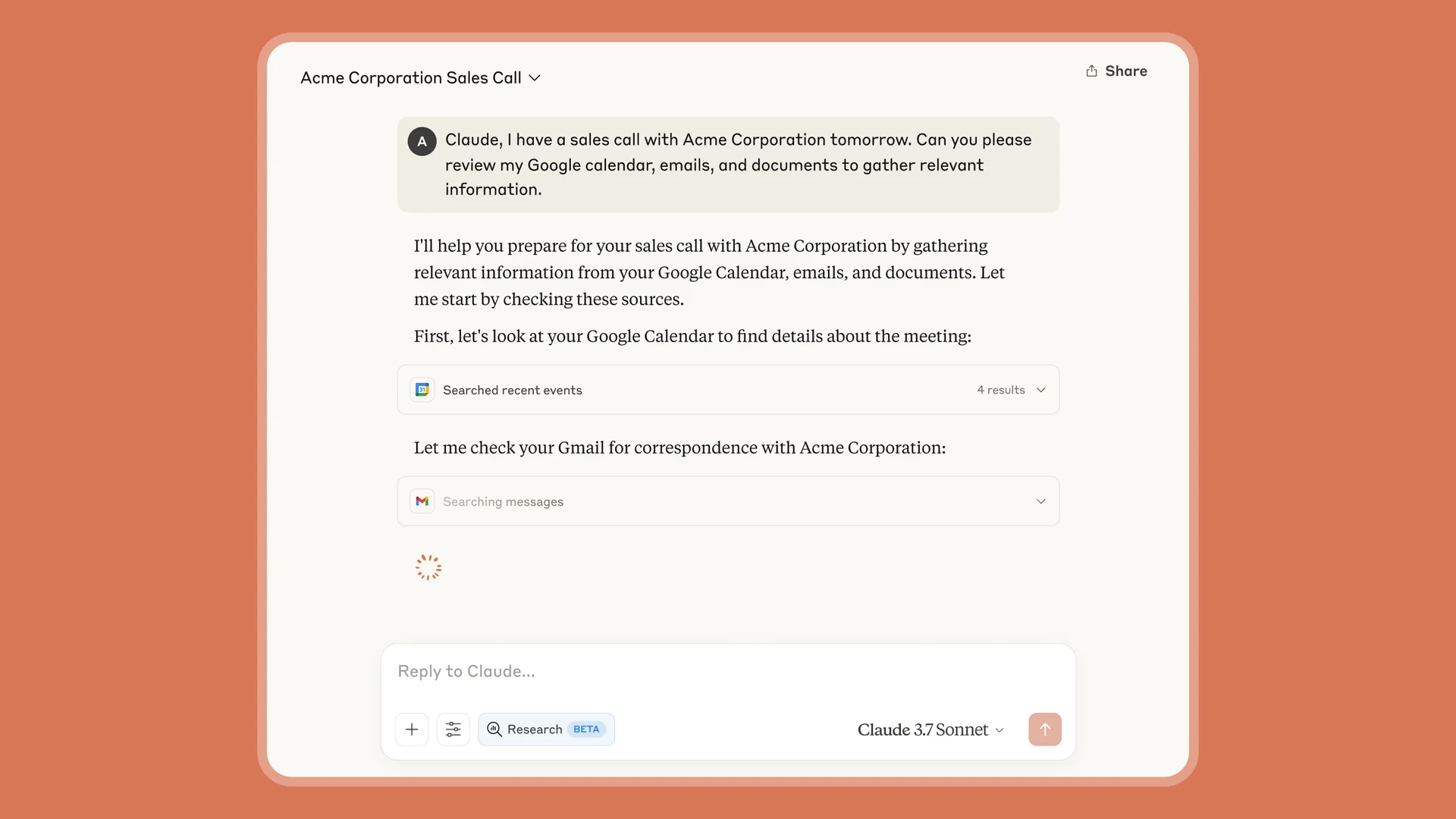
If you want one AI agent to help with everyday work, Claude is my first recommendation. It handles writing, organizing information, data analysis, design and coding very well. I especially like its conversational style and personality: discussing a task with it feels more like talking it through with a colleague. Often, a brief explanation is enough for it to understand what you want to do.
- Main uses
- Documents, research and code
- Starting price and requirements
- $20 per person/month billed annually; two-seat minimum
- Main considerations
- Usage limits and actions available in connected apps
Pros
- Easy to talk through a task with.
- Strong across writing, analysis, design and coding.
Cons
- Usage allowances are individual and cannot be shared.
- Team requires at least two seats.
Handle a customer's request for extra work
Suppose you run a design studio. A customer originally ordered an event poster, but now wants a set of social media graphics included at the same price. Give Claude the agreed deliverables, the original quote and the customer's latest message, and ask it to help you work out a response.
Claude can compare the new request with the original agreement, identify the extra work and suggest ways to handle it. For example, it might propose reusing the poster's main design and adjusting the size and layout for social media. If the customer wants a new design for every graphic, it could suggest a separate quote for that work. It can also explain what each option includes and why the amount of work differs.
It can then turn those options into an email that acknowledges the customer's request, explains how you could accommodate it, and makes each option's scope and price clear. You can ask it to refer to earlier emails so the tone matches how you usually speak with this customer. I recommend checking that the proposal is practical, the pricing works for you, and you're comfortable with the delivery commitments. Once you're happy, tell Claude in the conversation to send it. With Gmail connected and authorized, Claude can email the customer directly. Email connections and sending
Work with documents and connected information
Claude Team supports shared projects and workplace connectors, and includes Claude Code and Cowork. If your business spends a lot of time on documents, research or code, you can evaluate how those capabilities fit the way you work.
Pricing and usage
Claude Team Standard seats cost $20 per person per month when billed annually, or $25 per person per month on monthly billing, with a two-seat minimum. Two people on annual billing pay $480 a year for the base subscription. These are U.S. prices before tax. Official plan details
Each member has their own usage allowance. If you've used yours up, you can't use a colleague's remaining allowance. Usage rules
I recommend starting with an individual plan for your everyday work. Consider Team when an individual plan no longer meets your usage or collaboration needs.
If you regularly hit the limits after moving to Team, you can upgrade only the people who need more usage to Premium and keep everyone else on Standard. Premium costs $100 per person per month billed annually, or $125 per person per month on monthly billing. Seats and usage limits
You can also enable usage credits to keep working after the included allowance runs out. This additional usage is charged at standard API rates, and you can set spending limits. Additional usage


2. ChatGPT Business: everyday work and agents your team can reuse
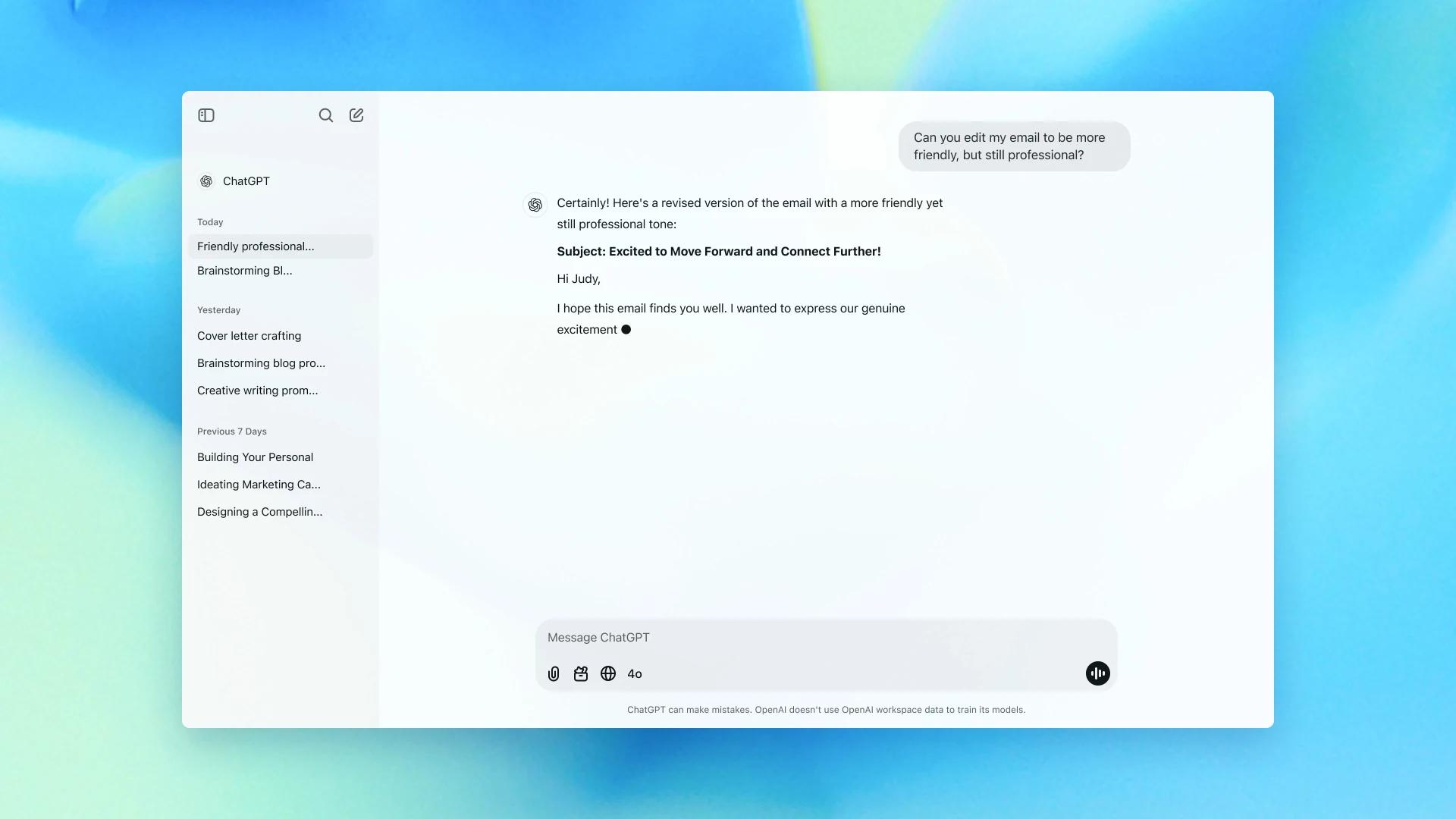
ChatGPT Business can be a useful place to start if you want help replying to customer emails, organizing research or analyzing sales spreadsheets. As well as chatting with it directly, your team can create a shared agent with instructions, reference files and tools. For example, you can give it product information and guidelines for customer replies so colleagues can use it to prepare drafts.
- Main uses
- Research, documents and shared agents
- Starting price and requirements
- $20 per person/month billed annually; two-seat minimum
- Main considerations
- Included usage and connected-app permissions
Pros
- Shared agents let colleagues reuse instructions and reference files.
- Sites can publish a website without separate server setup.
Cons
- I often need to adjust its overly formal writing.
- Frequent or complex work may require extra workspace credits.
When a small team receives a sales inquiry, preparing a reply often means checking price lists and delivery information. I think ChatGPT is a useful starting point for work like this, where the requirements are clear and the information needs to be organized carefully. One thing I appreciate is how thoroughly it follows instructions once I've explained them clearly.
For example, a customer's email might ask about the prices of several products, delivery times and customization. Give ChatGPT the email, price list and delivery information, and ask it to prepare a response to each question. It can make a separate list of questions the documents don't answer for you to confirm.
Its writing often feels too formal to me, though, and I usually need to adjust the tone. I prefer having it organize the information and prepare the draft, then letting the colleague responsible for the customer edit and send it.
Build a website for a new service or promotion
If you run a photography studio and are launching a new package, give ChatGPT the package details and portfolio photos, and ask it to create a mobile-friendly page showcasing the package.
I recommend checking the mobile experience first, particularly whether the price and contact options are easy to find. Tell it what needs changing, such as moving the package information higher on the page or changing the order of the photos.
Once you're happy with the content and design, you can publish the website directly through ChatGPT's built-in Sites feature. You don't need to buy a separate server or set up the hosting yourself. I think that makes it especially friendly to small businesses without IT staff. Sites documentation
Pricing and usage
ChatGPT Business charges per member. Standard seats cost $20 per person per month billed annually, or $25 per person per month on monthly billing, with a two-seat minimum. Two people on annual billing pay $480 a year for the base subscription. If you're the only person using it for now, I recommend comparing individual plans before buying a team subscription. Official pricing
The plan includes a usage allowance. A short reply and a task involving several documents and repeated website revisions use different amounts of that allowance. Model choice and task complexity also affect usage. If you reach the limit, you can buy workspace credits to keep using supported features. Include those credits in your budget if your team runs these tasks frequently. API calls are billed separately. Usage and cost

3. Offloop: bring AI agents onto your team as digital employees
If you want agents to join your team like employees and keep working alongside colleagues, I suggest looking at Offloop. It's the product we're building, and our team uses it to run our company.
- Main uses
- Teamwork with AI agents
- Starting price and requirements
- Private beta / custom team pilot
- Main considerations
- Access and available features
Pros
- People and agents can continue work in a shared Channel.
- Shared memory and Skills carry useful information and methods into later work.
Cons
- Access is currently invitation-only.
- Team Pilot pricing requires a custom quote.
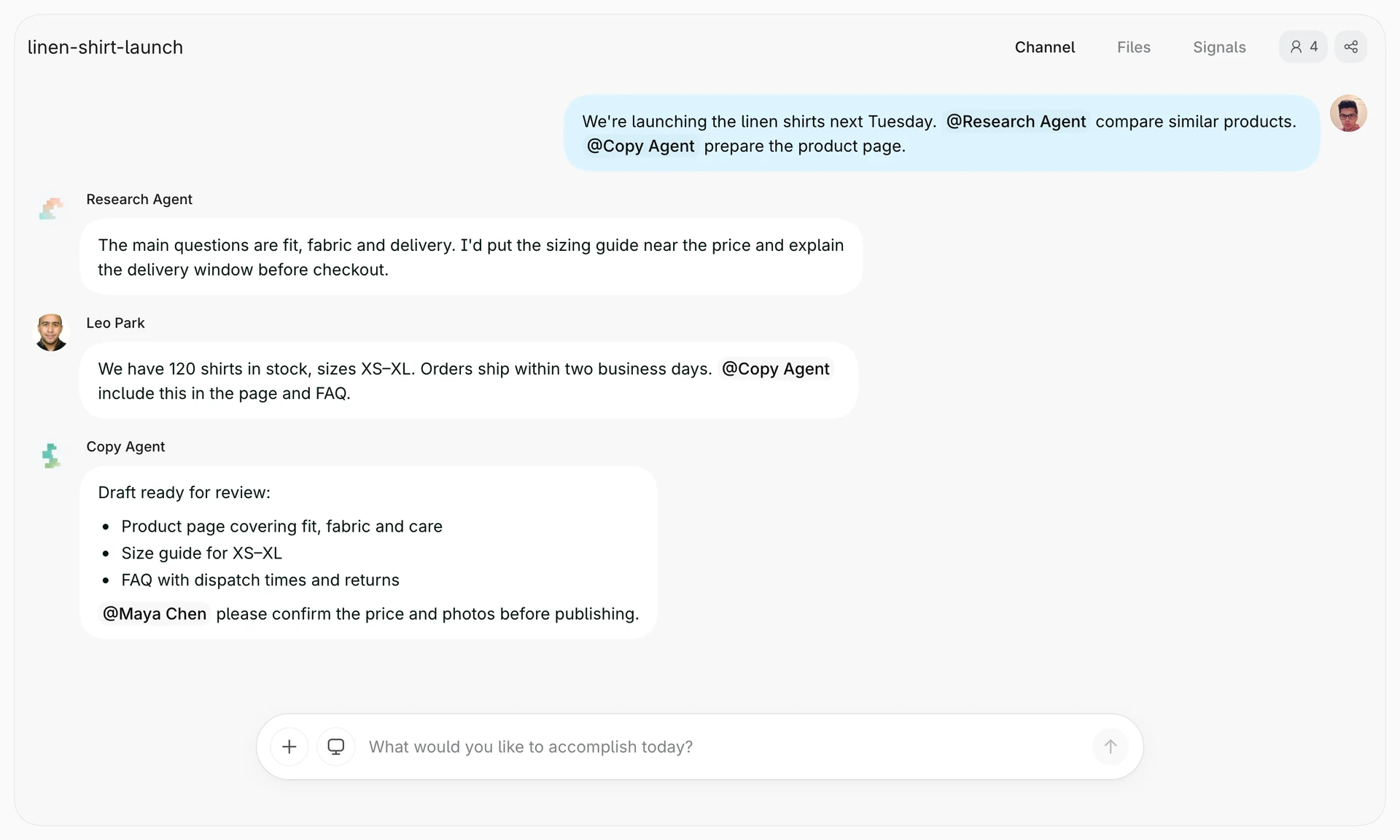
You can discuss customer requirements and share documents in the same Channel, then bring agents into the conversation to research, prepare proposals or carry out tasks. When a colleague adds a new customer requirement, you can ask an agent to revise the proposal and continue the work in that conversation.
Work with agents on a product launch
Suppose you and a few colleagues run a small online shop and are preparing to promote a new product. I recommend putting the product information, target audience and launch date in one Channel, where agents and the colleagues handling operations and customer support can work together.
Give different agents different jobs: one can research similar products' prices and selling points, while another prepares promotional copy from your product information. Operations can add stock and shipping details, and customer support can contribute common questions. Agents can use that information to improve the launch plan.
For example, if support finds that customers are most concerned about getting the right size, they can add that to the Channel and ask an agent to use the product information to prepare a sizing guide and revise the page copy. After launch, keep sharing sales results and customer feedback, and ask the agent to analyze which descriptions need changing and what to try next.
Keep what the team learns for future work
You and your colleagues can save the product details, brand voice and recurring customer questions established during the launch in shared memory for future work.
I also recommend documenting methods that work well and saving them as a shared Skill. That might cover which information to compare when researching similar products, how to organize selling points in promotional copy, and what to check before handing over a draft. When you promote another product, agents used by other colleagues can follow the same method with the new product information.
Pricing and access
Offloop is currently in private beta, with access by invitation. Team Pilot has custom pricing and includes shared Channels, team memory, connector setup and onboarding support. Pricing and access
When you apply for access, I recommend bringing a task your team is already working on, such as customer research, a product launch or organizing support information. See what agents can take on for the team, then expand from there.
4. Zapier: add AI to workflows you already use
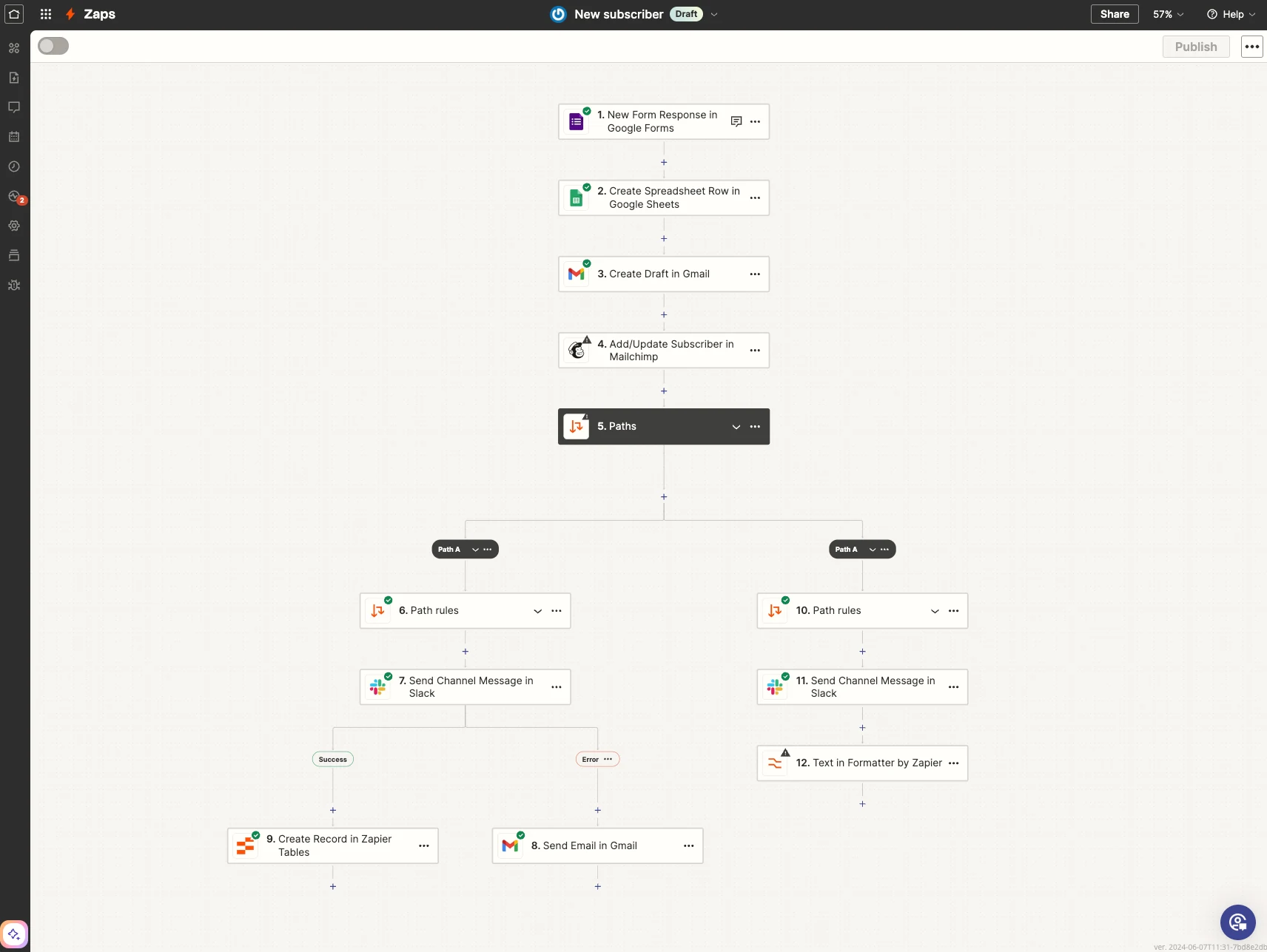
If you already use Zapier to handle customer forms, sync spreadsheets or send notifications, you can add AI steps to those workflows. For example, AI can interpret a customer's message and organize the request before the next steps record the information and notify a colleague.
- Main uses
- Cross-app workflows
- Starting price and requirements
- Professional from $19.99/month billed annually
- Main considerations
- Task consumption and AI-step plan requirements
Pros
- Add AI to existing app connections and workflows.
- Classify inquiries before routing them to sales or support.
Cons
- Building and maintaining workflows takes time.
- AI steps need a paid plan to publish and can consume several tasks.
I rarely build these workflows from scratch now, mainly because setup and maintenance take time. For a small team just starting with AI, I recommend trying Claude, ChatGPT or Offloop on a specific job first. Adding AI to a Zapier workflow that's already running well is a more compelling use.
Separate sales inquiries from support requests
Suppose you run an air-conditioning installation business and already use Zapier to log website inquiries in your customer records and notify sales. But the same form receives both requests for installation quotes and reports of problems with units you've already installed. Sending everything to sales means someone has to forward the support requests again.
I recommend adding an AI step to interpret the message. For example, “I'd like a quote to install two air conditioners” is a sales inquiry, while “The air conditioner you installed last week keeps leaking; please arrange a repair” is a support request.
The workflow can then send an organized summary of the customer's request to sales or support as appropriate. You can keep the steps that record customer information and send notifications, adding the AI classification and the rules for routing each type of request. AI by Zapier features
Pricing and usage
Zapier Professional starts at $19.99 per month billed annually, with prices varying by task allowance. The free plan includes 100 tasks a month, but only lets you preview AI by Zapier. You need a paid plan to publish those AI steps. Official pricing
One workflow run doesn't necessarily use just one task. An AI step that doesn't call other tools uses one task on Standard or five on Premium. New steps default to Premium. Other billable actions in the workflow count separately. AI task pricing
For the inquiry-routing example, I recommend trying Standard first and checking whether it classifies the messages accurately. Keep it if it meets your needs, and consider a higher model tier if it doesn't. That gives you a clearer way to judge whether the extra cost improves the result.

5. n8n: add AI to your order process
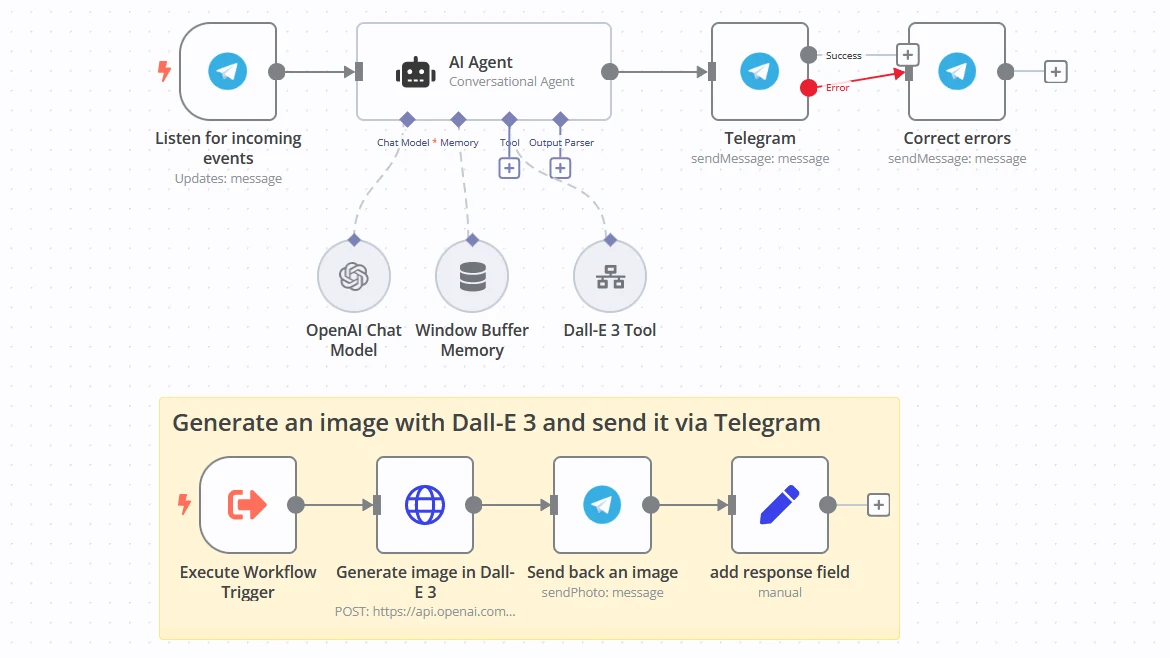
If orders arrive by email but inventory records live in another system, each order can mean sorting through product details, checking quantities and notifying colleagues. You can use n8n to connect those steps.
- Main uses
- Flexible workflows
- Starting price and requirements
- Hosted Starter at €20/month billed annually
- Main considerations
- Setup work, model costs and hosting
Pros
- Community Edition has no software subscription for internal self-hosted workflows.
- Cloud execution counts cover a whole workflow run.
Cons
- Self-hosting needs server maintenance and technical support.
- Some workflow and account-sharing features require a paid edition.
I recommend starting with an order process you repeat regularly. For example, have AI extract product specifications and quantities from a customer's email, then query the connected inventory system and prepare an order for confirmation. AI interprets the written request; quantity conversions, stock checks and notifications follow the rules you set.
This suits small teams with a defined business process that want to reduce repeated data entry. Someone needs to connect the business software, update the rules and deal with problems during a run. If you self-host, server maintenance is part of that work too.
Pricing and usage
n8n offers a free, source-available Community Edition. If your business already has IT staff and a server, you can deploy it yourself for internal workflows without paying an n8n software subscription. Community Edition licensing
If several colleagues need to maintain workflows together and share access to workflows and connected app accounts, consider a paid edition that includes those features. When you use an external model API, its usage is billed under that provider's terms. Edition differences
The official n8n Cloud Starter plan costs €20 a month billed annually, with 2,500 workflow executions a month. Official pricing
n8n counts each run of the whole workflow as one execution. In the order example, extracting the order, checking inventory and notifying a colleague count as one execution if they all happen in a single run of that workflow. Estimate how many executions you need from monthly order volume and how often your other scheduled workflows run.
Starter allows five concurrent executions, with a five-minute limit per run. I recommend trying real orders to see whether processing time and peak workload fit the plan.

6. Lindy: connect customer emails, meetings and follow-ups
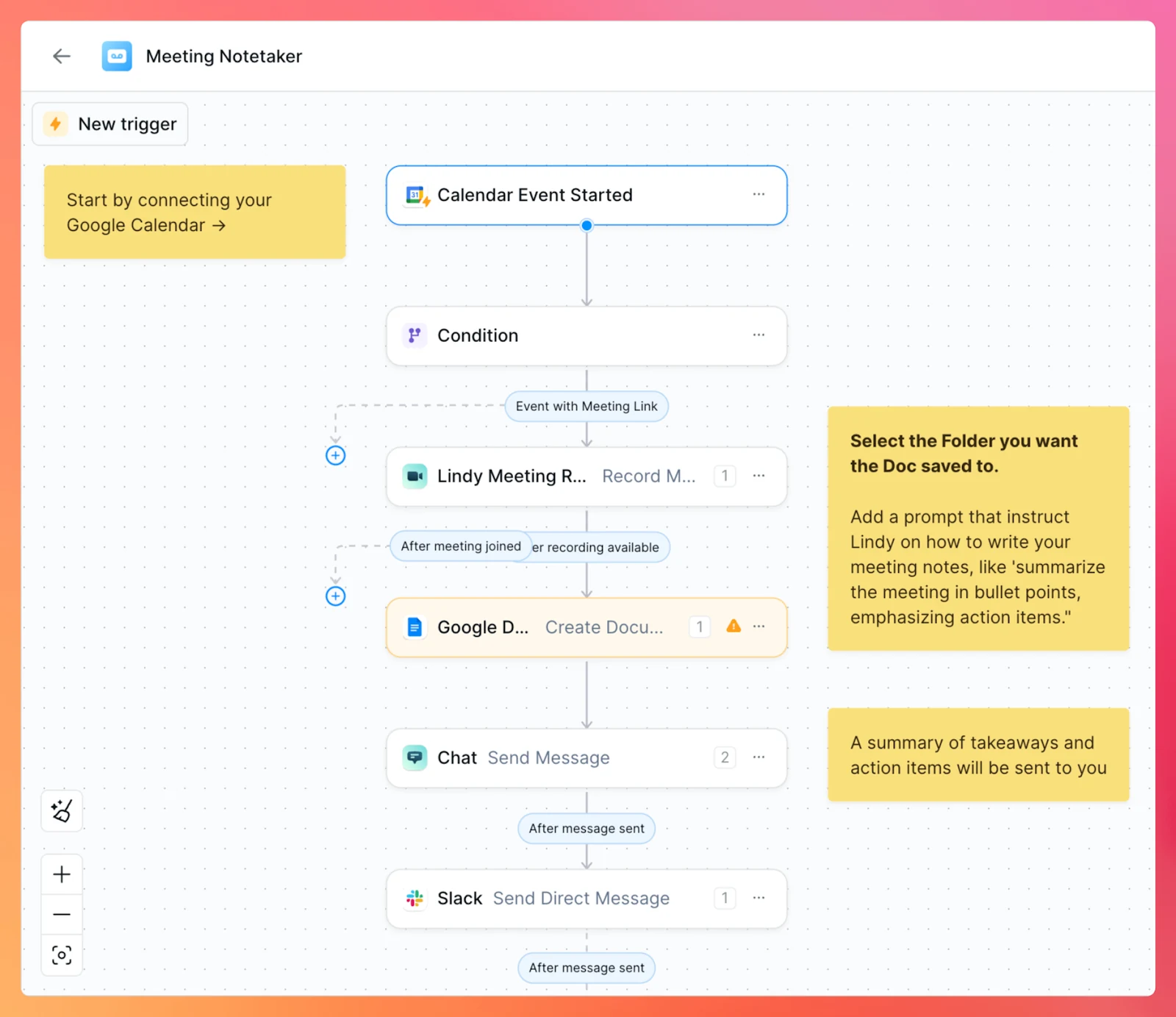
If customer requirements are scattered across emails and meeting notes, you may have to search through them again before every follow-up. Lindy connects to email, calendars and customer-management tools. It can use earlier conversations to prepare meeting briefs, summarize decisions and handle follow-up tasks.
- Main uses
- Email, calendars and recurring work
- Starting price and requirements
- From $29.99 per active user/month, including 3,000 credits
- Main considerations
- Active-user seats and usage credits
Pros
- Connect meeting decisions with email, tasks and customer records.
- Team credits go into a shared balance.
Cons
- Each active teammate is billed.
- Included monthly credits do not roll over.
I recommend starting with daily customer follow-ups. Ask it to put together the emails needing a reply, that day's customer meetings and outstanding follow-up tasks each morning, so you can see what needs your attention.
Follow through on what you promised in a customer meeting
Suppose you run a small consulting business and have just finished a customer meeting. You agreed to expand the service proposal, send relevant case studies and arrange another conversation. Those jobs involve email, files and calendars, and still take time to organize after the call.
Once you've connected your calendar and chosen which meetings it should join, Lindy can record the meeting and organize what was agreed: requirements, promised deliverables, who will handle each item and when it is due. You can then ask it to draft a follow-up email, create tasks or update a connected customer-management tool. Meetings and follow-up work
I recommend having the email clearly separate what each side needs to do: which proposal you'll send, for example, and which information the customer still needs to provide. Once you approve the content, Lindy can send it through a connected inbox. Before the next conversation, ask it to use that meeting and the subsequent emails to prepare a brief, so you can pick up where you left off. Connections and setup
Pricing and usage
Lindy Team starts at $29.99 per active user per month, including 3,000 credits. Each active teammate is billed, and everyone's credits go into a shared team balance. Official pricing
Credit consumption depends on the work Lindy does. Included monthly credits don't roll over. You can top up at $10 per 1,000 credits, and those top-up credits remain until you use them.
I recommend using the $50 in trial credits on real customer emails and meetings first. The credits are valid for seven days, and no credit card is required. Use the trial to see how many credits you consume each day before choosing a monthly allowance. Trial and billing details


7. Intercom Fin: handle recurring support questions first
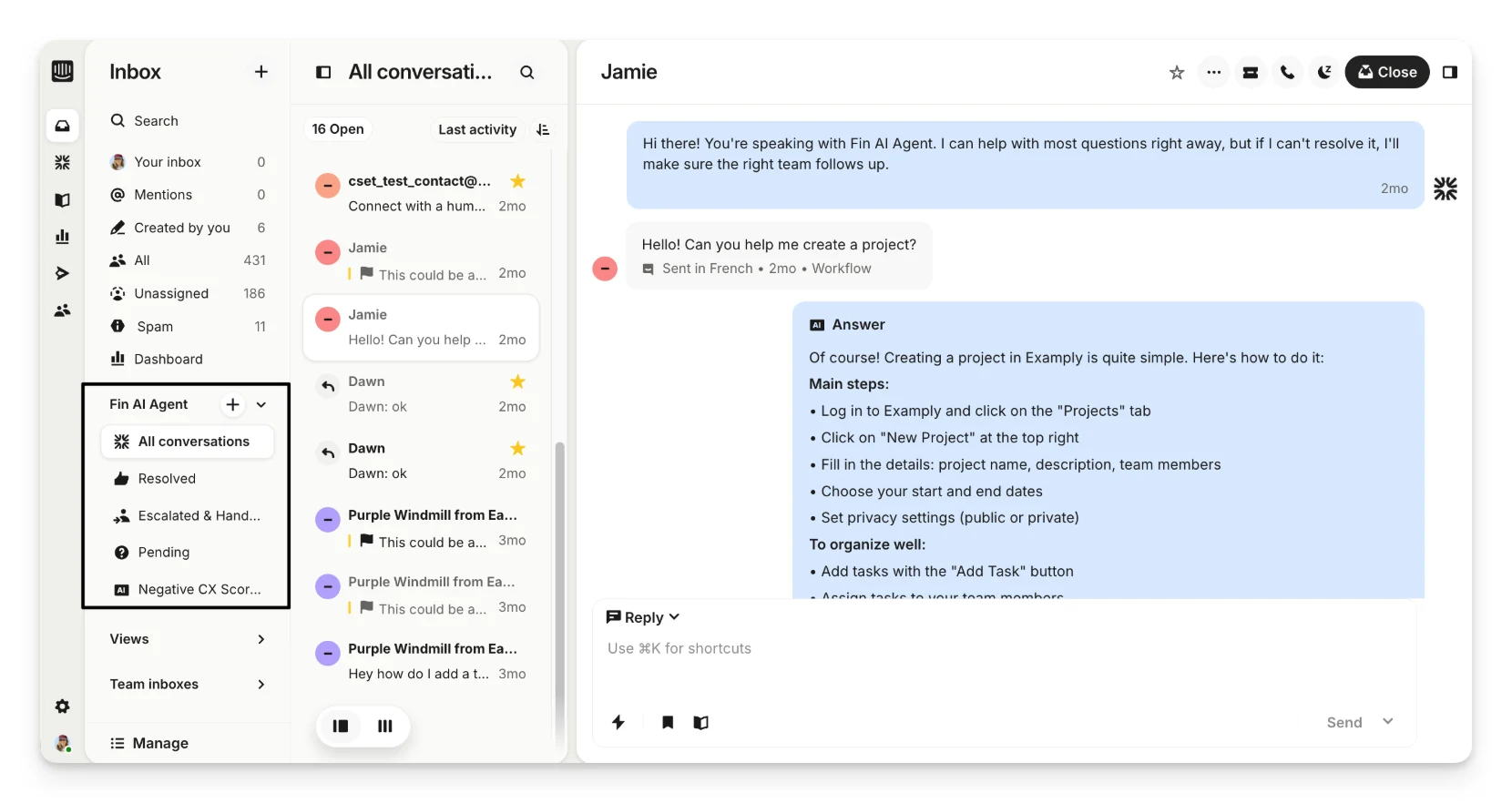
If customers ask you every day about delivery times, return policies and how to use your products, consider Fin. It can answer customers directly using the business information you provide. When a conversation needs human help, it can pass it to your support colleagues with the conversation history.
- Main uses
- Customer support
- Starting price and requirements
- From $0.99 per billable outcome
- Main considerations
- Minimum commitments and possible helpdesk costs
Pros
- Answer recurring questions from business information.
- Pass conversations to support colleagues with their history.
Cons
- A customer not asking for more help can also count as a billable outcome.
- Minimum commitments and helpdesk or channel costs may apply.
I recommend starting with a common question that has a clear answer. Organize the relevant policies and FAQs first. If you already have a helpdesk, you can connect Fin to it and let colleagues continue the conversation in the workspace they know.
Fin starts at $0.99 per outcome. A billable outcome can be a resolved question, a response after which the customer doesn't ask for more help, or a completed Procedure, which may include a handoff. Each conversation is charged once. Using Fin with an existing helpdesk may involve a minimum commitment; Intercom's helpdesk and some channels carry additional costs. Intercom pricing
Three small-business workflows to evaluate first
Answer a customer question from approved information
Start by drafting a reply to a recurring question using an approved help document. The inputs are the question and current source material. The expected result is an accurate answer, with a suitable handoff if information is missing. Have a person review it before sending. This is an illustrative example, not a claim that every product in the list supports the same workflow.
Prepare a prospect brief before a sales conversation
Use customer information you're authorized to access to prepare a short brief: who the prospect is, what you know and what to ask next. Check the facts and distinguish evidence from assumptions. Updating a CRM or contacting the prospect is a separate action that needs the appropriate tool and authorization.
Draft a weekly report from a defined set of updates
Give the agent a clear reporting period and the information it should use. Ask it to organize completed work, open issues and missing updates for review. A missing update doesn't prove the work is complete. Compare review time and usefulness before expanding the automation.
These examples show why task fit matters more than the length of a product list. The business still needs a responsible person, source information and a way to handle exceptions.
How to choose an AI agent for a small business
Choose an agent with both the task and the person who will maintain it in mind. Before buying, define the result you want, the total time and money you can commit, and who will handle exceptions.
Choose one recurring job
Define the input and expected output before choosing a product. That might be a weekly research summary or routing common inquiries. Include human review and a way to handle work the agent can't complete.
Estimate a month of real usage
Estimate how many people will use it and how many runs, tasks, credits, conversations or outcomes you'll need. Vendors use different units. Include any required office-suite, helpdesk, model and hosting charges, and check minimum commitments.
Review access before connecting business data
Confirm which account is connected, what the agent can read or change, and whether sending, updating or deleting requires approval. Start with a small pilot and review the logs and results before extending access.
Keep the first deployment small enough to understand. Add subscriptions or workflows when the actual work and review effort justify them.
Choose the agent for the job
Start with one useful task, shortlist the product category that fits, and estimate costs at your expected volume. A short pilot tells you more than advertised starting prices alone.
Frequently asked questions
Answers to common questions about choosing an AI agent for a small business.
Can a small business use AI agents without coding?
Some products provide ready-to-use assistants or visual workflow builders, but setup still takes work. The technical skills required depend on the tools, integrations and actions involved.
Are there free AI agents for small businesses?
Some vendors offer free plans, trials or self-hosted editions. Check what's available on that tier: a free automation plan may not let you publish a particular AI workflow, and self-hosting still requires infrastructure and maintenance.
Should an AI agent send messages automatically?
That depends on the risks and available controls. For customer messages, payments or record changes, decide who can approve the action and review early results before allowing broader automation.
Sources and pricing
- Claude Team: Email connections and sending Anthropic
- Claude Team: Official plan details Anthropic
- Claude Team: Additional usage Anthropic
- ChatGPT Business: Workspace Agents OpenAI
- ChatGPT Business: Sites documentation OpenAI
- ChatGPT Business: Official pricing OpenAI
- ChatGPT Business: Usage and cost OpenAI
- Offloop: Pricing and access Offloop
- Zapier: AI by Zapier features Zapier
- Zapier: Official pricing Zapier
- Zapier: AI task pricing Zapier
- n8n: Community Edition licensing n8n
- n8n: Edition differences n8n
- n8n: Official pricing n8n
- Lindy: Official features Lindy
- Lindy: Meetings and follow-up work Lindy
- Lindy: Connections and setup Lindy
- Lindy: Official pricing Lindy
- Intercom Fin: Official features Intercom
- Intercom Fin: Intercom pricing Intercom
- Intercom Fin: Inbox screenshot source Intercom
- Claude: Chat with Google Workspace Anthropic
- ChatGPT: Chat interface example OpenAI
- Zapier: Workflow editor example Zapier
- n8n: Agent workflow example n8n
- Lindy: Meeting workflow screenshot Lindy