
Which model fits which kind of work?
Match the model to your inputs, coding needs and everyday team work
Short answer: pick Gemini 4 Argon for long multimodal work, GPT-6.1 Sol for complex coding on a budget, and Claude Sonnet 5.5 for everyday team work.
- Gemini 4 Argon: Long, multi-step work over large inputs, including video, audio and PDFs.
- Google describes it as its flagship reasoning model for complex software engineering, multi-step agents and long decode up to 1M tokens. It is the only one of the three that accepts video and audio input.
- GPT-6.1 Sol: Complex coding, computer use and professional work when cost matters.
- OpenAI positions it as near-Astra performance at a lower cost, with reasoning effort from low to max.
- Claude Sonnet 5.5: Everyday team work such as coding fixes, documents, slides and spreadsheets.
- Anthropic positions it as the mid-tier 5.5 model for everyday work, with the full 1M context at standard pricing.


Start with the work you need to do: long multimodal inputs, cost-conscious complex coding or everyday team tasks. Use those needs to narrow the choice before comparing the detailed specifications.
How do the specs compare?
All three offer large context windows, while Gemini also accepts video and audio
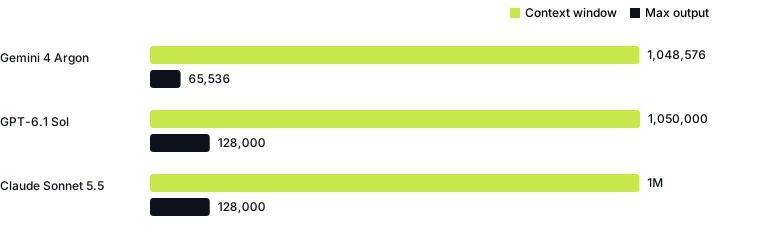
Short answer: all three offer about one million tokens of context; only Gemini 4 Argon reads video and audio.
| Gemini 4 Argon | GPT-6.1 Sol | Claude Sonnet 5.5 | |
|---|---|---|---|
| Vendor | OpenAI | Anthropic | |
| Release | GA Oct 13, 2026 | Sep 29, 2026 | Sep 28, 2026 |
| API model ID | gemini-4-argon | gpt-6.1-sol | claude-sonnet-5-5 |
| Context window | 1,048,576 tokens (input and output combined) | 1,050,000 tokens (max input 922,000) | 1M tokens |
| Max output | 65,536 by default, up to 1,048,576 with long decode | 128,000 tokens | 128,000 tokens (up to 300K on Batch API, beta) |
| Input types | Text, image, video, audio, PDF | Text, image | Text, image |
| Reasoning control | Thinking: low, medium, high | Effort: low, medium, high, xhigh, max | Adaptive thinking, effort setting (default high) |
| Knowledge cutoff | Apr 30, 2026 | Jun 2026 |
Choose around the inputs and output length your task needs, rather than context size alone: the models differ in supported media, output limits and reasoning controls.
How much do they cost through the API?
Matching headline rates can produce different costs for long prompts and caching
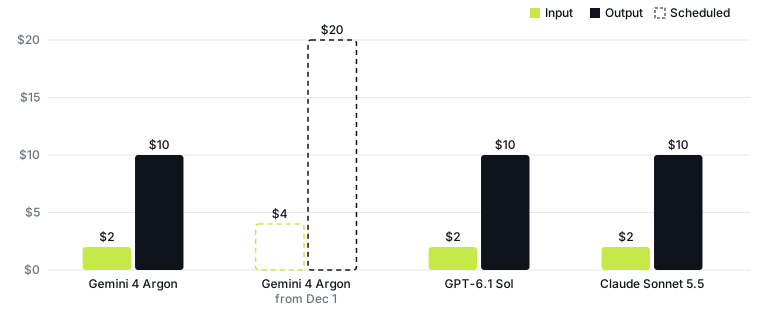
Short answer: All three list the same $2 input and $10 output today, so the real cost difference comes from long prompts, caching and how many tokens each model uses to finish a task. Gemini 4 Argon's price doubles on December 1.
| Model | Input | Output | Cached input | Notes |
|---|---|---|---|---|
| Gemini 4 Argon | $2 | $10 | Introductory price through Nov 30, 2026. Google's docs list $4 input and $20 output from Dec 1, 2026. | |
| GPT-6.1 Sol | $2 | $10 | $0.1 | Prompts over 272K input tokens cost 2x input and 1.5x output for the whole request. Batch and Flex are 50% lower. |
| Claude Sonnet 5.5 | $2 | $10 | $0.1 | The full 1M context is billed at the same per-token rate. |
USD per 1M tokens, standard tier. Prices checked 2026-10-22.
Compare the rate that applies to your prompt length, caching and usage tier, and account for the scheduled Gemini price change when estimating future costs.
Frequently asked questions
Which is cheapest: Gemini 4 Argon, GPT-6.1 Sol or Claude Sonnet 5.5?
Right now all three list $2 per million input tokens and $10 per million output tokens. Gemini 4 Argon's price rises to $4 and $20 on December 1, 2026. GPT-6.1 Sol charges more for prompts over 272K tokens, while Claude Sonnet 5.5 bills its full 1M context at the same rate.
Which model has the largest context window?
All three offer about one million tokens. GPT-6.1 Sol lists 1,050,000 with a 922,000 input cap, and Gemini 4 Argon lists 1,048,576 shared between input and output.
Which model can read video and audio?
Of the three, only Gemini 4 Argon accepts video and audio input. GPT-6.1 Sol takes text and images.
Is GPT-6.1 Sol available in ChatGPT?
At release it was available in ChatGPT Work, Codex and the API, but not yet in the main ChatGPT chat.
Can a team use more than one of these models?
Yes. Many teams pick a model per job, for example a cheaper model for summaries and a stronger one for code. An AI teammate in team chat can route work this way so people don't have to switch tools.